Features / How it learns

Calibrated on the jobs you already quoted.

A copied pricing configuration gets the physics right and your rates wrong. Give it two or three quotes you have already sent and what you charged for them, and it solves for your hourly rate — then keeps learning from every job you finish.

The problem with a copied brain

Physics travels between shops. Your rates do not.

A new account starts with a full pricing configuration, because most of what is in one is real physics: a 0.1 mm layer costs more everywhere, a tighter tolerance costs more everywhere, a bigger part costs more everywhere. What does not travel is what you charge for machine time. Start on somebody else's hourly rate and you are wrong in whichever direction your market differs, and the only way to find out is to lose jobs or leave money on the table for a year.

So the software asks for something every owner already has: two or three jobs you quoted recently, and what you charged for them. From those it solves for your rate.
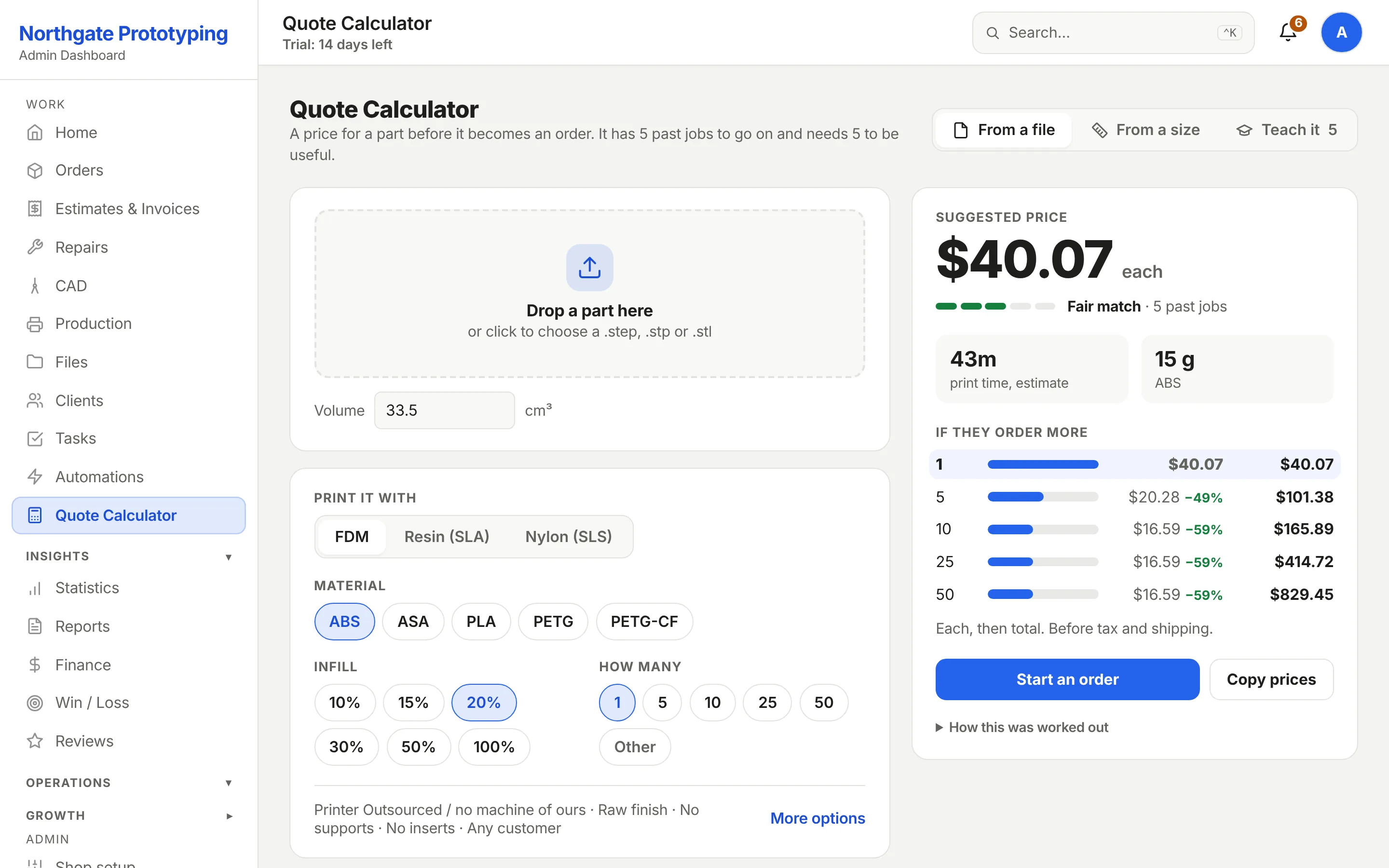
The internal calculator showing an engine price beside the price the shop actually charged, with the difference and a control to apply the learned rate.

Why one number

It fits your hourly rate, and nothing else.

Three jobs cannot honestly identify the twenty-odd multipliers in a pricing configuration. Fit more parameters than the data supports and you get a configuration that reproduces those three jobs exactly and everything else worse — it feels precise and it is wrong.

Why the fit is exact, not iterative

low rate high rate total probe 1 probe 2 your rate
An order total is affine in the hourly rate: every term is either proportional to it or independent of it, and the quantity discount, turnaround multiplier and card fee are all linear on top. So the software prices each of your jobs twice through the real engine, recovers the straight line exactly, and least-squares fits the one rate that best reproduces what you actually charged. Probing the engine rather than re-deriving its formula is why this stays correct when the engine changes — which it has, repeatedly.

Then it keeps learning

Every job you finish is a data point.

The fitted rate gets you to roughly right on day one. After that the engine has something better than three remembered jobs: the quotes you sent, the ones you won, and what the work actually cost when it came off the machine.

Quote error, before and after learning

before 46% after 15%
How far the engine's prices sat from the shop's real ones, before and after it learned from a year of completed jobs. Measured at the Ontario print shop Layers3D was built in — your numbers will differ, which is the whole point of fitting them to you.

The pricing engine in full →  ·  A price before there is a file →

Bring three quotes you have already sent.

That is the whole setup. Founding Shops get Professional at CA$119.20 a month for their first year, and your prices stay hidden from customers until you say otherwise.

Become a Founding Shop