Features / Quote without a file

A price before there is a file.

No model, no geometry, and a customer waiting. The honest answer is a range — and this one comes from how solid your own parts have actually turned out to be, priced through the same engine every upload goes through.

On the phone

“Roughly a metre long, in PETG — what would that run?”

There is no file. There is no geometry. There is a person waiting for an answer, and the two useless replies are a made-up number and “send me a model”. So the software answers with a range, from dimensions and a material alone, and it can defend every end of it.

A bounding box does not determine a volume. A truss a metre long and a solid block a metre long are two different jobs by an order of magnitude, and any single number pretending otherwise is a guess wearing a quote's clothes.

  • Length, width, height and a material — nothing else to fill in
  • You state the unit. Inches are converted once and echoed back in millimetres, so you can see what was actually priced
  • The range is priced through the same engine every upload and re-quote goes through, so it can never disagree with your real quoter
  • Too little measured history to be honest about? It says so, and falls back to engineering defaults rather than dressing up a guess
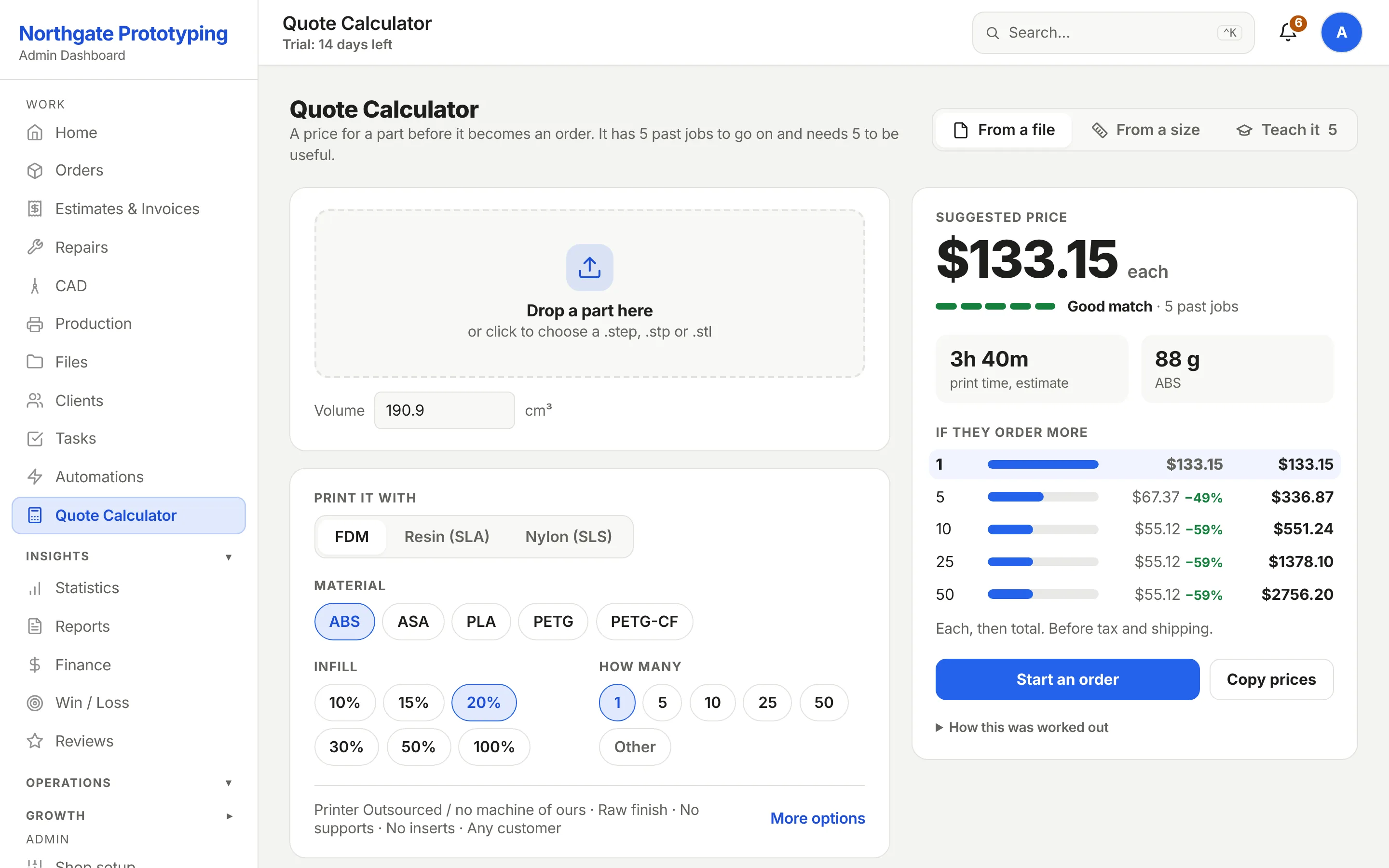
The internal quote calculator with technology, printer, material, volume, infill, finish and quantity tiers, and the estimated material weight and print time.

Where the range comes from

Your own parts, and how solid they turned out to be.

Every part your shop has measured tells you something: what fraction of its bounding box a real part actually fills. Collect enough of them and the spread of that fraction is the range.

How much of its bounding box a real part fills

3% 20% 57% sparse median solid 0% 100%
The tenth percentile, the median and the ninetieth across the fifty-one measured parts at the shop Layers3D was built in. Three volumes come out of those three fractions, each priced properly, and the low and high ends become the range you read down the phone. As your own measured history grows, the band narrows to your work.
Low end

Sparse, hollow, ribbed

Brackets with lightening pockets, enclosures, anything designed to use as little material as it can get away with.

Middle

What most parts are

The number to quote if the caller cannot tell you more. It is the median of real work, not an average of extremes.

High end

Solid and chunky

Jigs, fixtures, tooling and anything that has to take load. Quote this end when they say the part is solid.

Why the unit is never guessed

An inch is 25.4 millimetres, and a file will not tell you which it meant.

An STL carries no units. The same bytes are a five millimetre part and a five inch part, so a system that guesses is wrong half the time — and wrong by a factor of 16,387 by volume. One real job in this software's history was quoted at fifteen dollars when it was worth eight hundred, for exactly that reason. Nothing rescales geometry on a hunch any more: implausibly small measurements are flagged for a person, and on this page you say the unit yourself.

How a part with a file is measured →  ·  How the prices learn →

Answer the next one on the phone.

Founding Shops get Professional at CA$119.20 a month for their first year. The range gets better the more of your own parts it has measured.

Become a Founding Shop